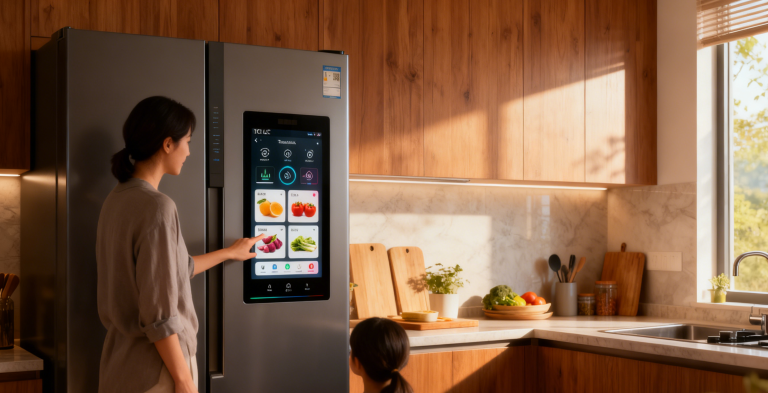
Most refrigerators haven’t changed much in appearance over the past decade. But for OEMs and appliance brands, one component is rapidly redefining product value and user perception—the TFT display for refrigerators.
Today’s consumers expect more than temperature control. They expect an intuitive, interactive interface that feels premium and smart. A well-designed TFT display for refrigerators is no longer just a screen—it’s a core HMI component that improves usability, supports smart features, and directly influences purchasing decisions at the showroom.
In other words, a high-quality TFT display isn’t just about aesthetics—it’s a core feature that enhances usability, signals premium quality, and directly influences buying decisions. In the sections below, we’ll explore how TFT displays improve the user experience, support smart home integration, and even boost showroom sales, with real-world examples from SanShun Smart’s collaboration with Haier and Casarte.
Executive Summary: The Strategic Value of a TFT Display for Refrigerators
Upgrading to a TFT display for refrigerators delivers measurable benefits across UX, engineering, and sales performance:
- Premium visual experience with high-resolution, full-color LCD panels
- Clear, intuitive HMI that replaces cryptic codes with real-world instructions
- Higher perceived product value, supporting premium pricing strategies
- Seamless IoT and smart-home integration via modern UI platforms
- Proven impact on showroom conversion rates and brand differentiation
In short, TFT displays translate complex internal technology into something users can instantly understand—and trust.

How a TFT Display for Refrigerators Transforms User Experience
When you compare two refrigerators side-by-side:
- One shows “4°C” on a basic LED panel
- The other features a 7-inch TFT LCD touchscreen with icons for freshness modes, humidity zones, and smart alerts
Which one would you touch first? Which one feels worth the price?
A TFT display for refrigerators transforms the appliance into an interactive hub. Users can adjust zones, receive maintenance reminders, monitor food freshness, or integrate with other smart kitchen devices—all through a familiar, smartphone-like interface.
This isn’t about adding unnecessary features. It’s about reducing friction in everyday use.
Benefits of TFT Displays for Refrigerators
1. Clear Communication Through Advanced HMI
Traditional displays rely on symbols and error codes like “E1” or “F3.” A TFT display can clearly state:
- “Left door open.”
- “Water filter replacement required.”
This clarity reduces user frustration and significantly lowers after-sales support calls—an often overlooked cost advantage for OEMs.
2. Touch Interaction Users Already Understand
With capacitive touch panels, TFT displays support smooth navigation, gestures, and multi-page menus. This aligns perfectly with how users already interact with smartphones and tablets, making the learning curve almost zero.
TFT Display vs LED/LCD for Refrigerators
Choosing display technology determines how advanced your software and UX can be.
| Feature | Segment LED | Monochrome LCD | Industrial TFT LCD |
|---|---|---|---|
| Color Depth | Single color | Grayscale | 16.7M colors |
| Resolution | Fixed segments | Low | HD / WVGA |
| Touch Support | No | Limited | Capacitive multi-touch |
| Viewing Angle | Poor | Average | Wide (IPS) |
| UI Capability | Static | Text-based | Animations, icons, video |
A TFT display for refrigerators removes UI limitations and opens the door to future software upgrades.
Case Study: Haier & Casarte — Setting a New Industry Benchmark
A real-world example shows how display strategy directly impacts market leadership.
SanShun Smart × Haier Smart Display Innovation (2019–2021)
In 2019, SanShun Smart partnered with Haier to redesign the user interface for its premium Casarte refrigerator line. Instead of adopting a power-hungry Android solution, the team developed a custom RTOS-based TFT display module, purpose-built for appliance environments.
Key milestones:
- 2019 – Innovation Phase RTOS-based TFT display platform developed for instant-on performance and long-term stability
- 2020 – Market Launch: First mass-produced Casarte models released, setting a new UX benchmark
- 2021 – Market Adoption RTOS TFT displays deployed in 80% of Casarte refrigerator models
This project demonstrated that a TFT display for refrigerators is not just a component—it’s a strategic driver of brand perception and market dominance.
Industrial Requirements for TFT Displays in Refrigerators
A refrigerator display must perform reliably for years in a challenging environment.
Optical Bonding (OCA/OCR)
Optical bonding eliminates internal air gaps, preventing condensation and fogging caused by kitchen humidity. It also improves contrast and readability under strong ambient lighting.
AG / AR Coatings for Visibility
Anti-glare (AG) and anti-reflective (AR) coatings ensure the display remains readable under bright kitchen lights and sunlight.
EMI / EMC Compatibility
Refrigerators are high-power appliances. Industrial TFT modules must meet strict EMI/EMC standards to prevent interference with compressors and control boards.
Industrial Interfaces
Support for RGB, LVDS, and I²C interfaces ensures compatibility with a wide range of refrigerator control architectures.
Buyer’s Checklist: Selecting the Right TFT Display for Refrigerators
Before finalizing a design, OEMs should ask:
- Stability: Does it support RTOS for instant-on performance?
- Durability: Is the display optically bonded to resist humidity?
- Visibility: Does it use IPS technology with wide viewing angles?
- Longevity: Is the backlight rated for 30,000–50,000 hours?
This checklist alone can eliminate most long-term reliability risks.
Standard Specifications (Typical Reference)
| Parameter | Common Range |
|---|---|
| Sizes | 3.5″, 5″, 7″, 10.1″ |
| Brightness | 300–1000 nits |
| Touch | Capacitive |
| Interface | RGB / LVDS / I²C |
| Operating Temp | -20°C to +70°C |
| Compliance | RoHS / REACH |
Elevate Your Product Line with SanShun Smart
Designing a reliable TFT display for refrigerators requires more than sourcing panels. It requires deep system-level expertise.
SanShun Smart specializes in industrial-grade TFT LCD and touch display solutions for smart home appliances, with proven experience in high-volume, long-lifecycle projects.
What partners gain with SanShun Smart:
- Full customization: size, FPC, cover lens, and interface
- Industrial reliability testing for humidity, vibration, and temperature
- Engineering-level integration support from concept to mass production
SanShun Smart is ISO-certified and designs products compliant with RoHS and REACH, meeting global OEM sourcing standards.
Looking for a reliable TFT display for refrigerators designed for a long lifecycle and mass production?
Conclusion: TFT Displays Are the New Standard
The TFT display for refrigerators is no longer optional in the mid-to-high-end market. It defines usability, influences purchasing decisions, and future-proofs appliances for smart ecosystems.
Brands that invest in high-quality TFT display solutions don’t just improve interfaces—they strengthen brand trust, increase conversion rates, and stay competitive in a rapidly evolving market.
FAQ: TFT Display for Refrigerators
Q: Why choose RTOS instead of Android for refrigerator TFT displays? A: RTOS offers instant boot, lower power consumption, and higher long-term stability—ideal for appliances that must always respond instantly.
Q: Can a TFT display for refrigerators handle vibration and humidity? A: Yes. Industrial-grade modules are designed with reinforced frames, optical bonding, and EMI/EMC protection.
Q: Does adding a TFT display significantly increase energy consumption? A: No. Modern TFT displays use auto-dimming and sleep modes to meet strict energy efficiency standards.
Q: Can one TFT display design support global markets? A: Absolutely. Language, units, and UI themes can all be localized through software without changing hardware.